![]()
Alexandria
|
||
|
Go to mint...
|
Alexandria (Diœcesis Orientis, province of Aegyptvs Iovia)Coins from Alexandria are in two groups, separated more or less at the death of Galerius in 311.
104-735
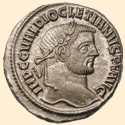
Diocletian augustus
—struck by Diocletian
Alexandria, 294
obv.- IMP C DIOCLETIANVS P F AVG; laur bust right
rev.- GENIO POPVLI ROMANI; Genius standing left, holding patera in left hand, cornucopiae in right; A in field, ALE in ex
RIC VI Ale 14a; Fail 006
27mm; 10.3g; nummus
First issue from Alexandria
104-671
Maximianus augustus
—struck by Domitius Domitianus
Alexandria, 295-296
obv.- IMP C MA MAXIMIANVS PF AVG; laureate bust right
rev.- GENIO POPVLI ROMANI; Genius standing facing, head left, modius on head, naked but for chlamys over left shoulder, liquors flowing from patera in right hand, cornucopiae in left; eagle | Γ infield; ALE in exergue
RIC VI Ale 18b; Fail 007
26mm; 10.4g; nummus
Struck under the control of Domitius Domitianus
104-984
Domitius Domitianus augustus
—struck by Domitius Domitianus
Alexandria, 297-298
obv.- IMP C L DOMITIVS DOMITIANVS AVG; laur bust right
rev.- GENIO POPVLI ROMANI; Genius standing facing, head left, holding patera and cornucopia; to left below, eagle standing left, head right; B in field; ALE in ex
RIC VI Ale 20; Fail 007
26mm; 9.85g; nummus
From the John A. Seeger Collection.
104-944
Diocletian augustus
—struck by Domitius Domitianus
Alexandria, 296
obv.- IMP C DIOCLETIANVS PF AVG; laureate bust right
rev.- GENIO POPVLI ROMANI; Genius standing facing, head left, modius on head, naked but for chlamys over left shoulder, liquors flowing from patera in right hand, cornucopiae in left; eagle * | B in field; ALE in exergue
RIC VI Ale 22a; Fail 007
26mm; 11.4g; nummus
Struck under the control of Domitius Domitianus
104-537
Maximianus augustus
—struck by Diocletian
Alexandria, 300
obv.- IMP C MA MAXIMIANVS PF AVG; laureate bust right
rev.- GENIO POPVLI ROMANI; Genius standing left, holding cornucopia and patera, ALE in ex, XXI | B in field
RIC VI Ale 30b; Fail 25
28mm; 10.8g; nummus
Scarcer variety with XXI in field -- only struck in single issue at Siscia and Alexandria
204-048
Constantius I caesar
—struck by Diocletian
Alexandria, 301
obv.- FL VAL CONSTANTIVS NOB CAES; laureate bust right
rev.- GENIO POPVLI ROMANI; Genius of the roman people standing left holding a patera and cornucopiae. XX in left field, Γ-I" in right field, ALE in ex
RIC VI Ale 33a
28mm; 9.7g; nummus
204-262
Maximianus augustus
—struck by Diocletian
Alexandria, 304-305
obv.- IMP C M A MAXIMIANVS PF AVG; Laureate bust right
rev.- HERCVLI VICTORI; Hercules standing facing, head left, leaning on his club and holding apples; a lion's skin hangs from his elbow; SP-gamma in fields; ALE in ex
RIC VI Ale 38; Fail 026
28mm; 9.1g; nummus
104-529
Constantius I caesar
—struck by Diocletian
Alexandria, 304-305
obv.- FL VAL CONSTANTIVD NOB CAES;
rev.- HERCVLI VICTORI; Hercules stg fcing, head left, leaning on club, holding apples, lion skin draped from elbow
RIC VI Ale 40; Fail 26
27mm; 10.9g; nummus
104-528
Diocletian augustus
—struck by Diocletian
Alexandria, 304-305
obv.- IMP C DIOCLETIANVS PF AVG;
rev.- IOVI CONS CAES; Jupiter stg left holding Victory on globe; S-Δ-P in fields, ALE in ex
RIC VI Ale 41; Fail 27
27mm; 10.2g; nummus
104-552
Galerius caesar
—struck by Diocletian
Alexandria, 304-305
obv.- GAL VAL MAXIMIANVS NOB CAES; laur b r
rev.- IOVI CONS CAES; Jupiter holding l, holding Victory on globe, leaning on sceptre; S|A/P in fields, ALE in ex
RIC VI Ale 43; Fail 27
26mm; 10.5g; nummus
104-881
Maximinus II caesar
—struck by Maximinus II
Alexandria, 305-307
obv.- GAL VAL MAXIMINVS NOB CAES; laur bust right
rev.- CONCORD IMPERII; Concordia standing facing, head left, leaning on sceptre and holding fold of drapery; S-Δ/P in fields, ALE in ex
RIC VI Ale 52; Fail 042
28mm; 8.1g; nummus
This is the twin to the Severus II coin with Concordia reverse.
104-963
Galeria Valeria augusta
—struck by Maximinus II
Alexandria, 308
obv.- GAL VALERIA AVG; Head r., diad., on facing bust in embroidered robes, with necklaces, on crescent
rev.- VENERI VICTRICI; Venus, stg. facing, head l., r. holding up apple, l. raising drapery over l.shoulder; In fields: ?-P | R; In ex: ALE
RIC VI Ale 74
25mm; 6.8g; nummus
104-638
Diocletian sr aug
—struck by Maximinus II
Alexandria, 308
obv.- DN DIOCLETIANO BAEATISS; consular bust right
rev.- PROVIDENTIA DEORVM; Providentia standing right extending right hand to Quies standing left who holds branch in right hand and leans on sceptre; dot • / A / XK in field, ALE in exergue
RIC VI Ale 80; Fail 052
24mm; 5.5g; nummus
From the Father Wilbur B. Dexter Collection.
204-029
Galeria Valeria augusta
—struck by Maximinus II
Alexandria, 308
obv.- GAL VALERIA AVG; Head r., diad., on facing bust in embroidered robes, with necklaces, on crescent
rev.- VENERI VICTRICI; Venus, stg. facing, head l., r. holding up apple, l. raising drapery over l.shoulder; B-X | K in fields; In ex: ALE
RIC VI Ale 81
24mm; 6.2g; nummus
204-094
Constantine I fil aug
—struck by Maximinus II
Alexandria, 308-310
obv.- FL VAL CONSTANTINVS FIL AVG; laureate bust right; divergent ties (α)
rev.- GENIO CAESARIS; Genius standing left, modius on head, naked except for chlamys over left shoulder, holding patera and cornucopiae, K in left field, A-P in right field, ALE in ex
RIC VI Ale 99b
24mm; 6.0 g; nummus
Coins with the filius augustorum title are much more common from the mints controlled by Galerius (such as Siscia and Thessalonica), since the title was his idea and he would have been interested in promoting it. Less common from mints controlled by Maximinus, who was anxious to ditch the whole concept ASAP. However, since Galerius was his patron, he had to acknowledge it to some extent, hence the scarce coinage such as this example. Constantine himself, not bound by any such concerns, never struck any coins with this title at any mints under his control, either in his name or Maximinus' name. Listed S in RIC.
204-256
Maximinus II caesar
—struck by Maximinus II
Alexandria, 308-310
obv.- GAL VAL MAXIMINVS NOB CAES; Laureate bust right
rev.- GENIO CAESARIS; K|epsilon-P in fields, ALE in ex
RIC VI Ale 100a; Fail 193
25mm; 6.8g; nummus
104-798
Maximinus II caesar
—struck by Maximinus II
Alexandria, 308-310
obv.- GAL VAL MAXIMINVS NOB CAES; l-b-r
rev.- GENIO CAESARIS; K|epsilon-P in fields, ALE in ex
RIC VI Ale 100a; Fail 193
24mm; 7.1g; nummus
"Damnatio" scratch across face. This is a rather evocative relic of the period. Galerius and Maximinus spearheaded the last and most vicious persecution of ancient Christian communities. A silent protest of many Christians was to deface the imperial portrait on their coins.
104-802
Licinius I augustus
—struck by Maximinus II
Alexandria, 308-310
obv.- IMP C GAL LIC LININIVS PF AVG; laur bust r
rev.- GENIO IMPERATORIS; K-Δ-P in fields, ALE in ex
RIC VI Ale 105b; Fail 197e
24mm; 6.5g; nummus
204-156
Constantine I augustus
—struck by Maximinus II
Alexandria, 308-310
obv.- FL VAL CONSTANTINVS AVG; Laureate bust right
rev.- GENIO IMPERATORIS; K-Δ-P in fields, ALE in ex
RIC VI Ale 108
26.5mm; 6.0g; nummus
204-115
Diocletian commem
—struck by Diocletian
Alexandria, 308
obv.- DN DIOCLETIANO BEATISS; laureate bust right, in imperial mantle
rev.- PROVIDENTIAE DEORVM; Providentia standing, extending hand to Quies standing, holding branch and leaning on sceptre, epsilon / KP in field, ALE in exergue
RIC VI Ale 109
mm; 7.0g; nummus
from T L Taylor Collection; ex Manton Associates, 1994
104-910
Galerius commem
—struck by Maximinus II
Alexandria, 311
obv.- DIVO MAXIMIANO MAXIMINVS AVG FIL; Laureate head right, divergent laurel ties
rev.- AETERMAE MEMORIAE GAL MAXIMIANI; Eagle standing left above garland on horned, lit altar; Crescent / K | G / P across fields ; ALE in exergue
RIC VI Ale 133; Fail 184
25mm; 7g; nummus
The reverse legend AETERNAE is misspelled as AETERMAE
104-590
Maximinus II augustus
—struck by Maximinus II
Alexandria, 311
obv.- IMP C GALER VAL MAXIMINVS P F AVG; laureate bust right
rev.- BONO GENIO PII IMPERATORIS; Genius holding patera and cornucopiae; crescent-K | A-P in fields, ALE in ex
RIC VI Ale 135b
24mm; 6.12g; nummus
This reverse type only struck in Alexandria 311-312 for a couple of officinae.
204-004
Licinius I augustus
—struck by Maximinus II
Alexandria, 311-312
obv.- IMP C VAL LIC LICINIVS PF AVG; Laur bust right
rev.- BONO GENIO PII IMPERATORIS; Genius stg facing, head left, pouring liquor from patera, cornucopia in left; crescent-K in left field, B X in right field; ALE in ex
RIC VI Ale 144a (var)
24mm; 7.6g; nummus
Another unlisted variety of this type. This one is unlisted for this obverse legend; 144a is listed as S
204-106
Alexandria civic issue
—struck by Maximinus II
Alexandria, 310-313
obv.- DEO SANCTO SARAPIDI; Head of Serapis right, wearing modius
rev.- DEO SANCTO NILO; Nilus reclining left, holding reed and cradling cornucopia in arm; Γ//ALE
Van Heesch, Last, 6b; Fail 226
15mm; 1.4g; quarter-nummus
This coin is part of a series of "civic" coinage that echoes the tradition of locally minted bronze coinage, intended for local commerce. Such coinage died out in the general economic malaise that preceded Diocletian. It is not entirely clear what purpose the present coinage served. The coins are very small; struck only at Alexandria, Antioch, and, rarely, Nicomedia; and mostly reflect local deities and themes. Are they actually intended for monetary use as small change? Commemorative tokens? A projection of Maximinus' stridently pagan religious policies, reacting to the pro-Christian policies of Constantine? Both sides of this coin show classic traditional iconography of Alexandria: on the obverse is Serapis, which was the most popular local deity in late Roman times; on the reverse is a personification of the Nile. 204-027
Constantine I augustus
—struck by Maximinus II
Alexandria, 312
obv.- FL VALER CONSTANTINVS PF AVG; laureate bust right
rev.- GENIO AVGVSTI; Genius standing left, holding head of Serapis and cornucopiae; N-A in fields, ALE•t in ex
RIC VI Ale 158 [var]
21mm; 4.9g; nummus
Legends match RIC 158 (listed as R in RIC), but officina A is not recorded. RIC notes that "Off. and B are not evidenced" at all for these entire groups of nummi. The dot following the mint mark is also not recorded for this group, but it is noted for other groups.
104-790
Maximinus II augustus
—struck by Maximinus II
Alexandria, 312-313
obv.- IMP C GAL VAL MAXIMINVS PF AVG; Laureate head right
rev.- GENIO AVGVSTI; Genius standing left, modius on head, naked but for chlamys across left shoulder, head of Serapis in right hand, cornucopiae in left ; * / N / palm in left field, B in right field; ALE in exergue
RIC VI Ale 160b; Fail 190
22mm; 5.6g; nummus
204-184
Constantine I augustus
—struck by Maximinus II
Alexandria, 312-313
obv.- FL VALER CONSTANTINVS PF AVG; laureate bust right
rev.- GENIO AVGVSTI; Genius standing left holding head of Serapis and cornucopiae, modius on head, */N/palm branch in field, A in right field, ALE in ex
RIC VI Ale 161
21mm; 5.3g; nummus
Rated S in RIC
104-672
Licinius I augustus
—struck by Maximinus II
Alexandria, 313
obv.- IMP C LIC LICINIVS PF AVG; laureate bust right
rev.- GENIO AVGVSTI; Genius standing left, holding head of Serapis and cornucopia; palm branch-N-* in left field, wreath-Γ in right field; ALE in ex
RIC VI Ale 162a; Fail 190q
22mm; 5.0g; nummus
from a small collection reputed to have been pieced out from Giovanni's Dattari's original collection of Alexandrian coinage. ex. Milivoj Paut
204-185
Constantine I augustus
—struck by Licinius I
Alexandria, 313-314
obv.- FL VALER CONSTANTINVS PF AVG; laureate bust right
rev.- GENIO POPVLI ROMANI; Genius standing left holding head of Serapis and cornucopiae, modius on head, N/palm branch in field, Γ-wreath in right field, ALE in ex
RIC VII Ale 2
21mm; 5.3g; nummus
Rated R4-R5 in RIC. This coin was struck shortly after Licinius defeated Maximinus in 313. Upon the defeat of Maximinus, all of the mints formerly under the control of Maximinus began striking "Iovi Conservatori" types like Licinius' other mints and ceased production of Maximinus types. For some reason, the Alexandria mint didn't follow this pattern and continued striking the "Genius holding head of Serapis" type from Maximinus. Exceptionally, the mint also reverted to the old "Genio Populi Romani" legend, in place of the "Genio Augusti" legend that had been used with this reverse type under Maximinus. Perhaps this was an attempt to project a message of tradition and continuity during this period of political change?
204-065
Constantine I augustus
—struck by Licinius I
Alexandria, 315
obv.- IMP C FL VAL CONSTANTINVS P F AVG; Laureate head right
rev.- IOVI CONSERVATORI AVGG; Jupiter standing facing, head left, naked but for chlamys over left shoulder, Victory on globe in right hand, scepter in left. Eagle holding wreath in left field; wreath-Z-N in right field, ALE in ex
RIC VII Ale 7
20mm; 3.0g; nummus
During most of the Roman Imperial period, Alexandria vied with Antioch for the position of Second City of the empire, surpassed only by Rome in importance. The province of Egypt had a privileged position relative to Rome, by virtue of its great wealth and historical importance; the unique circumstances of its acquisition by Octavian from Antony and Cleopatra; and, most importantly, because of its role as a food supplier to Rome. Since the time of Octavian, Egypt had been administered as a closed economic zone, minting its own coins instead of relying on imperial coinage. As part of his coinage reform, Diocletian ended this practice; henceforth, Egypt would use the same coins and monetary system as the rest of the empire. The first such coins were struck in 294 on the same model as the coins struck at all the other mints; that is, they were struck jointly for all the tetrachs, using the Genio Populi Romani reverse to emphasize unity with the rest of the empire. In 295, one of Diocletian's generals named Domitius Domitianus seized control of the city (and the mint), perhaps reflecting local dissatisfaction with the loss of Egypt's—and Alexandria's—special status. However, Domitianus continued to strike coins on Diocletian's model, and even struck coins in the names of other tetrarchs, including Diocletian himself. This was designed to create the impression that he was just one more member of the imperial college, rather than supplanting all of the other rulers. Nonetheless, a very displeased Diocletian promptly dispatched of Domitianus and reasserted control of the city, and coins in Domitianus' name ceased.
|
Timeline4,500(-ish) BC—Site is settled by Egyptians, known as Râ-Kedet (in Greek, Rhakotis) 331 BC — Alexander the Great founds αλεξάνδρεια — Alexandria. 323 BC — After Alexander's death, Ptolemy I makes it the seat of his kingdom and site of Alexander's tomb. 285-247 BC — Pharos of Alexandria (lighthouse), one of seven wonders of ancient world, is erected. c200 BC — Library founded — the greatest library of antiquity. 80 BC — Romans assume de facto control. 47 BC — Julius Caesar visits and meets Cleopatra. 31 BC —Cleopatra and Mark Antony commit suicide after Battle of Actium. Egypt becomes Roman province. 215 AD — General massacre carried out by Caracalla after public political satire. 250 — Arius born (ordained in 311). Alexandria becomes center of Arianism in early Christian church. 295 — Domitius Domitianus, general under Diocletian, rebels and assumes control of city and mint. 296 — Diocletian defeats Domitianus and reasserts control. 305 — Mint passes to control of Maximinus II after abdication of Diocletian. 313 — Mint passes to control of Licinius after death of Maximinus. 324 — City passes to control of Constantine after his final defeat of Licinius. 391 — Theodosius destroys all pagan temples. This probably finishes off the Library. 616 — Conquered by Persians under Khusro II. 626 — Reconquered by Byzantines under Heraclius. 642 — Conquered by Arabs. If Theodosius didn't destroy the Library, this did.
|
|
| ||