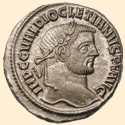
Welcome to Numisology!
Aquileia

Aquileia (Diœcesis Italiciana, province of Venetia et Histria)

The first page includes coins struck before Maxentius' revolt. Page 2 includes coins struck by Maxentius and after its reconquest by Constantine.

  • Coinage, 294–307
  • Coinage, 307–325
  • About Aquileia...
  • Map
104-794

(click image to see larger picture)

Constantius I caesar
—struck by Maximianus
Aquileia, 294
obv.- CONSTANTIUS NOB CAES; laureate bust right
rev.- GENIO POPVLI ROMANI; Genius standing l, holding patera and cornucopiae; AQ in ex
RIC VI Aq 19a; Fail 006
27mm; 10.7g; nummus
First issue from Aquiliea mint; rated R
104-877

(click image to see larger picture)

Maximianus augustus
—struck by Maximianus
Aquileia, 296
obv.- IMP MAXIMIANVS PF AVG; laur bust right
rev.- GENIO POPVLI ROMANI; Genius standing left, holding patera & cornucopia; AQS in ex
RIC VI Aq 23b
27mm; 10.8g; nummus
104-777

(click image to see larger picture)

Galerius caesar
—struck by Maximianus
Aquileia, 296
obv.- MAXIMIANVS NOB CAES; laur bust right
rev.- GENIO POPVLI ROMANI; Genius standing l, holding patera and cornucopiae;
RIC VI Aquileia 24b; Fail 006
29mm; 10.5g; nummus
104-987

(click image to see larger picture)

Diocletian augustus
—struck by Maximianus
Aquileia, 299
obv.- IMP DIOCLETIANVS P F AVG; laur bust right
rev.- GENIO POPVLI ROMANI; Genius standing facing, head left, holding patera and cornucopia; to left, saltire alter with flames; AQS in ex
RIC VI Aq 27a
28mm; 9.2g; nummus
204-307

(click image to see larger picture)

Galerius caesar
—struck by Maximianus
Aquileia, 300
obv.- MAXIMIANVS CAESAR; laureate bust right
rev.- XCVI AQ; legend surrounded by wreath
RIC VI Aq 17b, RSC 250b
19mm; 3.04g; argenteus
XCVI indicates the value of the coin = 96 / pound of silver. This was issued in connection with the monetary reform of 300-301 and indicates the new value of this denomination.
104-931

(click image to see larger picture)

Diocletian augustus
—struck by Maximianus
Aquileia, 300
obv.- IMP DIOCLETIANVS P F AVG; laur bust right
rev.- SACR MONET AVGG ET CAESS NOSTR; Moneta standing left, holding scales and cornucopia, AQS in exergue
RIC VI Aq 29a
27mm; 10.1g; nummus
104-879

(click image to see larger picture)

Constantius I caesar
—struck by Maximianus
Aquileia, 300
obv.- CONSTANTIVS NOB CAES; laur bust right
rev.- SACRA MONET AVGG ET CAESS NOSTR; Moneta standing left, scales in right hand, cornucopiae in left ; AQ-Γ in exergue
RIC VI Aq 30a
28mm; 10.3g; nummus
104-851

(click image to see larger picture)

Diocletian augustus
—struck by Maximianus
Aquileia, 301
obv.- IMP DIOCLETIANVS P F AVG; laureate bust right
rev.- SACRA MONET AVGG ET CAESS NOSTR; Moneta staning left, holding scales right and cornucopiae left; V in field; AQS in ex
RIC VI Aq 31a
26mm; 10.4g; nummus
204-213

(click image to see larger picture)

Diocletian augustus
—struck by Maximianus
Aquileia, 301
obv.- IMP DIOCLETIANVS PF AVG; Laureate bust right
rev.- SACRA MONET AVGG ET CAESS NOSTR; Moneta standing left holding scales and cornucopia; VI in fields; AQS in ex
RIC VI Aq 31a
26mm; 10.3g; nummus
104-524

(click image to see larger picture)

Constantius I caesar
—struck by Maximianus
Aquileia, 301
obv.- CONSTANTIVS NOB CAES; Laureate head right, divergent laurel ties
rev.- SACRA MONET AVGG ET CAESS NOSTR; Moneta standing left, scales in right hand, cornucopiae in left V in right field AQG in exergue
RIC VI Aq 32a
29mm; 10.47g; nummus
104-964

(click image to see larger picture)

Galerius caesar
—struck by Maximianus
Aquileia, 301
obv.- MAXIMIANVS NOB CAES; laur bust right
rev.- SACRA MONET AVGG ET CAESS NOSTR; Moneta standing with balance scales and conucopiae; V in field; AQ-Γ in ex
RIC VI Aq 32b
28mm; 8.8g; nummus
104-920

(click image to see larger picture)

Maximianus augustus
—struck by Maximianus
Aquileia, 302-303
obv.- IMP MAXIMIANVS PF AVG; laur bust right
rev.- SACR MONET AVGG ET CAESS NOSTR;
RIC VI Aq 35b
28mm; 8.8g; nummus
104-436

(click image to see larger picture)

Galerius caesar
—struck by Maximianus
Aquileia, 302-303 AD
obv.- MAXIMIANVS NOB CAES; Laureate bust right.
rev.- SACRA MONET AVGG ET CAESS NOSTR; Moneta standing left holding scales + cornucopia; III (VI?) in fields; in ex, A Q G
RIC VI Aq 36b; Fail 28
28mm; 8.6g; nummus
struck as caesar, 293-305 AD
104-995

(click image to see larger picture)

Constantius I caesar
—struck by Maximianus
Aquileia, 303
obv.- CONSTANTIVS NOB CAES; Laureate head right, divergent laurel ties
rev.- SACRA MONET AVGG ET CAESS NOSTR; Moneta standing left, scales in right hand, cornucopiae in left; AQΓ in ex., * in left field, VI in right field
RIC VI Aq 38a
29mm; 9g; nummus
Rated S in RIC. Plate coin for Failmezgar "Roman Bronze Coins" (Plate 2). ex Tory Failmezgar collection
204-018

(click image to see larger picture)

Galerius caesar
—struck by Maximianus
Aquileia, 304-305
obv.- MAXIMIANVS NOB CAES; laur bust right
rev.- SACRA MONET AVGG ET CAESS NOSTR; Moneta standing with balance scales and conucopiae; VI in right field, crescent in left field; AQ-Γ in ex
RIC VI Aq 40b
27mm; 9.9g; nummus
204-092

(click image to see larger picture)

Galerius augustus
—struck by Severus II
Aquileia, 305-306
obv.- IMP MAXIMIANVS PF AVG; Laureate head right
rev.- FIDES MILITVM AVGG ET CAESS NN; Fides standing left, holding two standards; AQP in ex.
RIC VI Aq 60b; Fail 44
29mm; 9.5g; nummus
Uncleaned, with original hoard patina. Really nice coin under the green encrustations.
104-657

(click image to see larger picture)

Galerius augustus
—struck by Severus II
Aquileia, 305-306
obv.- IMP MAXIMIANVS PF AVG; helmeted bust left; holding spear and shield
rev.- VIRTVS AVGG ET CAESS NN; Prince with shield, galloping right, spearing kneling foe, second foe prostrate on ground; AQP in ex
RIC VI Aq 66b; Fail 056
28mm; 9.2g; nummus
rated R in RIC, R in Fail
104-935

(click image to see larger picture)

Severus II caesar
—struck by Severus II as caesar
Aquileia, 305-306
obv.- SEVERVS NOB CAES; laur bust r
rev.- VIRTVS AVGG ET CAES NN; Mars advancing right in military dress, holding spear right and trophy over shoulder; in ex, AQΓ
RIC VI Aq 70a; Fail 055
28mm; 10.5g; nummus
Rated S in RIC, R in Failmezgar.
204-005

(click image to see larger picture)

Severus II caesar
—struck by Severus II
Aquileia, 305-306
obv.- SEVERVS NOB CAES; laur bust r
rev.- VIRTVS AVGG ET CAES NN; Mars advancing right in military dress, holding spear right and trophy over shoulder; in ex, AQG
RIC VI Aq 70a; Fail 055
28mm; 8.8g; nummus
rated S in RIC, R in Fail
104-863

(click image to see larger picture)

Maximinus II caesar
—struck by Severus II
Aquileia, 305-306
obv.- MAXIMINVS NOB CAES; laur bust r
rev.- VIRTVS AVGG ET CAES NN; Mars advancing right in military dress, holding spear right and trophy over shoulder; in ex, AQG
RIC VI Aq 70b; Fail 055
28mm; 9.1g; nummus
rated S in RIC, R in Fail
104-999

(click image to see larger picture)

Maximinus II caesar
—struck by Severus II
Aquileia, 305-306
obv.- MAXIMINVS NOB CAES; laur bust r
rev.- VIRTVS AVGG ET CAESS NN; Prince standing, holding Victory, leaning on spear and shield; captive at feet; AQ-Γ in ex
RIC VI Aq 72a; Fail 057
27mm; 10.1g; nummus
rated R in RIC, R in Fail
204-001

(click image to see larger picture)

Constantine I caesar
—struck by Severus II
Aquileia, 306-307
obv.- CONSTANTINVS NOB CAES; laur bust r
rev.- VIRTVS AVGG ET CAES NN; Constantine I on horseback riding right, spearing kneeling foe, second foe prostrate on ground, AQ(Γ) in ex
RIC VI Aq 82b; Fail 056
28mm; 9.2g; nummus
rated R in RIC, R in Fail
204-255

(click image to see larger picture)

Constantine I caesar
—struck by Maxentius
Aquileia, May/June 307
obv.- CONSTANTINVS NOB CAES; Laureate, draped, and cuirassed bust right, seen from behind
rev.- VIRTVS CONSTANTINI CAES; Constantine on horseback galloping right, holding round shield and casting spear at enemy prone before him; to left, second enemy lying dead with spear in body, AQΓ in ex
RIC VI Aq 111, Fail 164
29mm; 12.2g; nummus

listed as S in RIC, but that seems kind of understated. From the White Mountain Collection. Wonderful style, especially on the reverse: well-modeled figure with detailed armor and boots, beautifuly rendered horse, great detail with the flowing cape and tail. Wonderful example of 4th-century coinage. Click here for detail.

Interesting to compare this coin to 204-001, the previous coin in this series from Aquileia, which were struck by Severus II in the name of himself, Maximinus II, and Constantine. The emperor-on-horseback motif is the same, and Severus uses a generic legend VIRTVS AVGG ET CAESS for all the rulers. After Maxentius assumed control of the mint, he changed the legend to refer specifically to Constantine ("VIRTVS CONSTANTINI") and dropped Maximinus II, as part of his bid to gain Constantine's support.

204-171

(click image to see larger picture)

Maxentius augustus
—struck by Maxentius
Aquileia, 307
obv.- IMP C MAXENTIVS P F AVG; Laureate head right
rev.- CONSERV VRB SVAE; Roma seated left on shield in tetrastyle temple, presenting globe with right hand to Maxentius in military dress, scepter in left hand, seated captive between, Victories with wreaths as acroteria, wolf and twins in pediment AQP in exergue
RIC VI Aq 113
25mm; 6.1g; nummus
This coin isn't especially scarce, but it's tough to find with a complete, well-struck reverse; perhaps because the scene is so detailed, the dies tended to be fragile. However, the reverse of this coin is exceptional. The portrait is also very fresh and well-struck.
104-588

(click image to see larger picture)

Constantine I caesar
—struck by Maxentius
Aquileia, 307
obv.- CONSTANTINVS NOB CAES; Laureate head right
rev.- CONSERV-VRB SVAE; Roma seated facing, head left, in hexastyle temple, globe in right hand, scepter in left, shield at side, AQG in exergue
RIC VI Aq 117; Fail 127n
26.5mm; 6g; nummus
204-173

(click image to see larger picture)

Constantine I caesar
—struck by Maxentius
Aquileia, 307
obv.- CONSTANTINVS NOB CAES; laureate bust right
rev.- CONSERV VRB SVAE; Roma seated facing, head left, holding globe with standing Victory in right hand and sceptre in left; within hexastyle temple, wreath in pediment, in exergue, AQG
RIC VI Aq 117 var
26mm; 6.5g; nummus
Unknown variety with Victory standing on globe. There's many, many varieties of Roma seated in temple holding globe—presumably because the coin design is based on a real temple with a real statue—but I've never seen one that has Victory standing on the globe. This variety isn't listed in RIC, but is mentioned in Jeločnik's accounts of the Čentur hoard. In fact, this coin is a die match for that coin, as illustrated on Plate T.III # 60. See detail.
204-167

(click image to see larger picture)

Maximianus senior augustus
—struck by Maxentius
Aquileia, 307
obv.- IMP C MAXIMINIANVS P F AVG; Laureate bust right
rev.- CONSERV VRB SVAE; Roma seated front, head left, holding globe and scepter, shield behind throne, in six-columned temple with wreath in pediment; AQP in exergue
RIC VI Aq 118
28mm; 6.8g; nummus
Ex Jacob Stein Collection. Displayed at Cincinnati Art Museum, 1994-2008, no. 178. Detailed, well-struck reverse from dies of fine style.
204-061

(click image to see larger picture)

Maxentius augustus
—struck by Maxentius
Aquileia, 307-309
obv.- IMP C MAXENTIVS PF AVG; Consular bust right
rev.- CONSERV VRB SVAE; Roma in hexastyle temple; knobs as acroteria; crescent in pediment; AQS in ex
RIC VI Aq 121a;
25mm; 7.0g; nummus
104-857

(click image to see larger picture)

Maximianus sr aug
—struck by Maxentius
Aquileia, 307-308
obv.- IMP C MAXIMIANVS P F AVG; laureate head right
rev.- CONSERV VRB SVAE; Roma seated within hexastyle temple; star in pedimentAQP in exergue
RIC VI Aq 121c
25mm; 6.1g; nummus
rated S in RIC
104-915

(click image to see larger picture)

Constantius I commem
—struck by Maxentius
Aquileia, 307-310
obv.- DIVO CONSTANTIO AVG; veiled bust right
rev.- MEMORIA DIV-I CONSTANTI; eagle standing right, wings spread, holding wreath in beak, two-doored altar enclosure; in ex, AQP
RIC VI Aq 127; Fail 146
25mm; 5.76g; nummus
Struck by Maxentius to commemorate the death (and honor the memory) of Constantius, as part of his effort to curry favor with Constantine.
104-759

(click image to see larger picture)

Maxentius augustus
—struck by Maxentius
Aquileia, 309
obv.- IMP MAXENTIVS PF AVG CONS II; Consular bust right
rev.- CONSERV VRB SVAE; Roma in hexastyle temple; knobs as acroteria; crescent in pediment; AQS in ex
RIC VI Aq 125; Fail 127p
25mm; 5.7g; nummus
All of the tetrarchs at one time or another served as consul, an office that at this point in the Empire's history was largely ceremonial, but still carried weight because of its historical importance and connotations of legitimate power. Maxentius, however, was the only tetrarch who actually mentioned the office on his bronze coins, as on this obverse legend, "CONS II", commemorating his second consulship (except for a few rare coins by Maximinus II—who was also quite aggressive in promotional coinage). As a rebel, the question of legitimacy was vital to him. Since he had military control of Rome, he had little difficulty getting the Senate to vote him this traditional office. The portrait shows him wearing consular robes and holding the eagle-tipped scepter that was a symbol of the office. He also struck coins as CONS I and CONS III, to commemorate each of his three consulships.
204-145

(click image to see larger picture)

Constantine I augustus
—struck by Constantine I
Aquileia, 312-313
obv.- CONSTANTINVS PF AVG; Laureate, cuirassed bust right
rev.- SOL INVICTO COMITI; Sol standing left, raising hand and holding globe; seated captive to left
RIC VI Aq 144
22mm; 3.8g; nummus
This was struck shortly after Constantine assumed control of the mint in his war with Maxentius. At this time, Sol was recognized on Constantine's coins as his patron deity; the addition of the captive at Sol's feet would have been an unmistakeable allusion to his victory over Maxentius and the new political order in Aquileia.
104-872

(click image to see larger picture)

Constantine I augustus
—struck by Constantine I
Aquileia, 312-313
obv.- CONSTANTINVS PF AVG; Laur. and cuir. bust r
rev.- MARTI CONSERVATORI; In ex: AQS; Mars, stg.r., cloak hanging behind, r.hand leaning on reversed spear, l. resting on shield.
RIC VI Aq 141
22mm; 4.24g; nummus
listed as R in RIC
204-011

(click image to see larger picture)

Maximinus II augustus
—struck by Constantine I
Aquileia, 312-313
obv.- IMP MAXIMINVS PF AVG; laureate bust right
rev.- GENIO AVGVSTI; Genius -- nude except for cloak, towered -- stg left, holding patera over saltire alter; AQS in ex
RIC VI Aq 130; Fail 057
21mm; 4.5g; nummus

rated S in RIC

I don't think this RIC number is correct, though, someone remind me to correct it.

104-917

(click image to see larger picture)

Maximinus II augustus
—struck by Constantine I
Aquileia, 312-313
obv.- IMP MAXIMINVS PF AVG; laur bust right
rev.- SOL INVICTO COMITI; Sol standing left, raising hand and holding globe; seated captive to lef
RIC VI Aq 142
22mm; 4.3g; nummus
listed as S in RIC
204-224

(click image to see larger picture)

Licinius I augustus
—struck by Constantine I
Aquileia, 317
obv.- IMP LICINIVS PF AVG; laureate buirassed bust right
rev.- IOVI CONSERVATORI; Jupiter standing left, chlamys over shoulder, holding thunderbolt, leaning on sceptre
RIC VII Aq 7
20mm; 3.4g; nummus

More than perhaps any other mint, the coinage of Aquileia exhibits marked thematic shifts that reflect local Tetrarchy politics. This is a function of its location — initially, as one of the two mints adjacent to the great imperial capital of Mediolanum (the capital of Maximianus), and then later, on the front between Maxentius' rebellion and the forces of Severus and Galerius.

Initially, it struck the ubiquitous Genius coinage. After the Edict of Maximum Prices in 301, Aquileia minted vast quantities of Moneta-themed coins to promote the new policy, far more than other mints. Indeed, it is for the Moneta coins that the mint is best known. Aquileian coins of this period developed a distinctive, artistic style. Many people think that the Aquileian coinage of this period is the most beautiful of the entire Tetrarchic period, and high-grade examples are eagerly sought.

When Severus II was appointed Caesar in 305, the mint passed to his control, and the Moneta theme was replaced by openly military themes, foreshadowing the impending conflict with Maxentius.

When Maxentius took control of the city in 307, the coinage changed again. While the other tetrarchs strove to use the coinage to promote unity and harmony between themselves, Maxentius promoted Italo-centric themes — featuring the temple of Roma — to emphasize his role as protector of the city and Italy. He did not strike coins in the names of the other tetrarchs. However, he did strike coins in the name of his father, to emphasize his dynastic connection, and in the name of Constantine, as part of a constant effort to win his support and alliance. In this connection, he also struck commemorative coins in honor of Constantius (Constantine's father) on his death.

This mint, along with Ticinum, was closed by Maxentius around 310—perhaps as a reaction to Constantine's growing power in Gaul. The mint was reopened in 312 after Constantine's defeat of Maxentius and was quickly brought into the fold with Constantine's other mints. However, it only stayed open for a year. In 313 it closed again and did not reopen until after Constantine's first civil war with Licinius in 317.

Interestingly, during the year 312/313, there was a decided Licinian tilt to the Aquileian coins. This was the only one of Constantine's mints that struck the IOVI CONSERVATORI types that were Licinius' signature. In addition, the "Genius" coins from this period had the GENIO AVGVSTI legend that was only struck in the eastern mints; all of Constantine's other mints used the GENIO POPVLI ROMANI legend. (In addition to the two Licinian types, it struck Constantine's Sol & Mars types, consistent with Ticinum and/or Rome.)

In spring 313, Licinius was in Mediolanum (Milan) with Constantine (culminating in the historic Edict of Milan). Licinius must have travelled through Aquileia before this period on his way to Mediolanum, and again later in 313 heading to war with Maximinus II. So the period during which the mint was open roughly corresponds to Licinius' time in the area. So one wonders:

  • Was the purpose of opening the mint to supply coins to Licinius' forces that must have been in the region?
  • Were the Licinian and Constantinian types really struck at the same time, or were they struck in two consecutive groups? Was the mint controlled by Licinian officials at first, then taken over by Constantinian officials, perhaps when Licinius' forces moved on?
  • Aquileia was hard by Licinius' other territories. After Maxentius closed the mint in 310, the closest operating mint was Siscia, controlled by Licinius, who had just moved into the area following the death of Galerius. It is not inconceivable that he was interested in projecting his authority further into the Aquileia region.

After Constantine reopened it for good in 317, Aquileia remained an important imperial city (and mint) until the 5th century, when it passed under Gothic, and then Lombard control. It was gradually eclipsed in importance by Venice in the middle ages.


Timeline

181 BC — City founded as Roman colony.

c60 AD — Hermagoras appointed first bishop, by St. Mark. (Martyred in 70 AD.)

168 AD — Marcus Aurelius strengthens city as major fortress against barbarians.

293 — Mint established under control of Maximianus.

305 — Control of mint passes to Severus II, after abdication of Maximianus.

307 — Maxentius assumes control of mint.

312 — Constantine assumes control of mint.

313 — Christian basilica dedicated.

452 — City sacked by Huns and almost destroyed.

590 — Sacked by Lombards.

1031 — Cathedral constructed by Poppo, inaugurating civic renaissance.