Welcome to Numisology!
Carausius & Allectus

A rival empire in Britain

  • Coinage
  • Biography
  • Map
204-206

(click image to see larger picture)

Carausius augustus
—struck by Carausius
Camulodunum, 288
obv.- IMP CARAVSIVS P AVG; radiate, draped and cuirassed bust right
rev.- LAETITIA AVG; Laetitia stg. left, holding wreath & anchor; C in ex
RIC V.ii 262
26x24mm; 4.4g; antoninianus
Rated R in RIC. Markedly double-struck on reverse.


104-673

(click image to see larger picture)

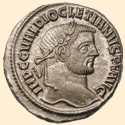
Diocletian augustus
—struck by Carausius
Camulodunum, 290-292
obv.- IMP C C VAL DIOCLETIANVS P AVG; radiate cuirasssed bust right
rev.- PAX AVGGG; Pax standing, holding branch and sceptre; S|P in fields, C in ex
RIC V 19
23mm; 4.5g; antoninianus
This coin was minted by Carausius in Diocletian's name. The obverse is the usual type of the time, but with Diocletian's legend: IMP C C VAL DIOCLETIANVS P AVG. The reverse documents Carausius' desire for recognition: it shows a figure of Pax, the personification of Peace, with the legend PAX AVGGG, meaning "Peace of our Three Augusti"...in this case Carausius plus Diocletian and Maximianus. In this way Carausius demonstrated his recognition of the other two Augusti...and by implication, the assumption that they recognized him, or at least should.
204-249

(click image to see larger picture)

Allectus augustus
—struck by Allectus
London, 293-296
obv.- IMP C ALLECTVS P F AVG; Radiate, draped, cuirassed bust right
rev.- VIRTVS AVG; Galley rowing left, waves below; QL in ex
RIC V.II 55
20mm; 2.9g; quinarius
ex. S. Beagle Collection
103-148

(click image to see larger picture)

Allectus augustus
—struck by Allectus
Clausentum / Camulodunum, 295
obv.- IMP C ALLECTVS PF AVG, radiate draped bust right; IMP C ALLECTVS PF AVG, radiate draped bust right
rev.- LAETITA AVG, galley right under oars, C in ex; LAETITA AVG, galley right under oars, C in ex
VM 10, RIC 128
20mm; 2.7g; quinarius
Fished this out of a batch of uncleaned coins. The galley commemorates the source of Allectus' power—his fleet.

Carausius was not a Roman, but a member of the Menapi, one of the Belgic tribes living on the periphery of the Roman empire. He served in the Roman forces under Maximianus and rose to the command of a fleet charged with partrolling the Rhine and coastal areas to combat piracy. In 287 he rebelled against Maximianus and, in the tradition of Postumus a generation earlier, created a parallel state to the mainstream Roman empire in Britain and northern Gaul.

In 287 Diocletian's coinage reforms had yet to be implemented, so the British corner of the empire was chronically underserved with coinage. Carausius quickly began striking coins that were the equal or—or even superior to—official Roman coinage, enhancing his prestige nad proclaiming his authority.

Maximianus attempted to reconquer the area but initially was unsuccessful. The need to dislodge Carausius was a major reason why Constantius was appointed Caesar in 293. Constantius won a significant victory over Carausius that year and assumed control over Carausius' continental territory. This removed Carausius' control over both sides of the English Channel and gave Constantius several ports that he could use as a staging area for his eventual invasion of Britain proper, including the key port of Bononia.

It was probably after this defeat that Carausius was assasinated and replaced by his chief minister, Allectus. Allectus continued striking coins in his own name. However, the overall quality of the coins did not match Carausius, and Allectus conspicuously did not try to strike coins in the name of the other emperors. Allectus was unable to reverse Carausius' military fortunes, however, and was defeated in short order when Constantius' forces moved into Britain.

Carausius' coinage, for the most part, was similar to that of the rest of the empire. This was before Diocletian's reforms which created the large bronze follis seen throughout this site; instead, the common bronze coin was the antoninianus, as shown here. Most of the coins were struck in his own name, but he also struck coins in the name of Diocletian and Maximianus as part of an attempt to reach compromise with them; the idea probably was that he would recognize them if they would recognize him.

Carausius established not just a mint, but a network of mints to implement his programs. In addition to a mint in Londinium, Carausius operated a second mint in Britain, indentified by the letter "C" on the coins. While its precise location is not known for certain, current belief is that the mint was Camulodunum (modern Colchester). Coins were also struck in northern Gaul in Rotomagus (modern Rouen).

The circled cities indicate the known (or very likely) mint cities.


Timeline

286—Carausius is commissioned to combat Saxon and Frankish pirates in coastal waters of Gaul & Germany.

287 — Condemned by Maximianus, perhaps for keeping pirate loot. Flees to Britain with fleet and proclaims himself emperor.

289 — Maximianus' own fleet destroyed—perhaps by storm,perhaps by Carausius. Constantius—then a general under Maximianus—defeats Carausius' Frankish allies.

290 — Maximianus again fails to drive Carausius from Gaul.

293 — Constantius appointed caesar. Besieges and retakes Bononia. Carausius murdered and replaced by Allectus, who retreats to Britain.

296 — Constantius and his chief general, Asclepiodotus, each launch fleets. Asclepiodotus defeats Allectus in battle while Constantius marches into Londinium.