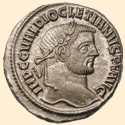
Welcome to Numisology!
Carthage

Carthage (Diœcesis Africæ, province of Africa Zvegitana)

Coins from Carthage are split into two groups, divided by the revolt of Maxentius in late 306.

  • Coinage, 294-306
  • 306-308
  • About Carthage...
  • Map
204-017

(click image to see larger picture)

Diocletian augustus
—struck by Maximianus
Carthage, 296-298
obv.- DIOCLETIANVS AVG; laureate bust right
rev.- F ADVENT AVGG NN; Africa standing facing, head left, holding standard and tusk; at feet, lion standing left; bucranium to left; P
RIC VI Car 13a; RSC 64
18mm; 3.4g; argenteus
Rare; rated R3 in RIC
104-789

(click image to see larger picture)

Maximianus augustus
—struck by Maximianus
Carthage, 297
obv.- IMP MAXIMIANVS PF AVG; laur bust right
rev.- FELIX ADVENT AVGG NN; Africa standing left holding standard and elephant's tusk, lion at feet; B in field; PKS in ex
RIC VI Car 21b; Fail 001
28mm; 9.5g; nummus
Ex Manfra Tordella and Brookes 1968; rated S in RIC
104-568

(click image to see larger picture)

Diocletian augustus
—struck by Maximianus
Carthage, 298
obv.- IMP DIOCLETIANVS PF AVG; laur bust right
rev.- FELIX ADVENT AVGG NN; Africa stg facing, head l, in long drapery; holding standard r and elephant tusk l; PKA in ex, I in right field
RIC VI Car 25b; Fail 1
28mm; 8.7g; nummus
 
204-163

(click image to see larger picture)

Constantius I caesar
—struck by Maximianus
Carthage, 298-299
obv.- CONSTANTIVS NOB CAES; laur bust right
rev.- SALVIS AVGG ET CAESS AVCTA KART; Carthage standing, holding fruits in both hands; Γ in ex
RIC VI Car 28a
25mm; 9.1g; nummus
"SALVIS … AVCTA KART" ("blessed Carthage") was only used as the reverse legend for a single issue (the first), after which it was replaced by "SALVIS … FEL KART" ("happy Carthage"), which wound up being used for all future issues of this type. This variety is rated S in RIC.
104-973

(click image to see larger picture)

Galerius caesar
—struck by Maximianus
Carthage, 298-299
obv.- MAXIMIANVS NOB CAES; laur bust right
rev.- SALVIS AVGG ET CAESS FEL KART; Karthago standing facing, head left, in long robe, fruits in both hands ; Δ in ex
RIC VI Car 30b
27mm; 8.9g; nummus

One of my favorite portraits in my collection. Listed as S in RIC
104-840

(click image to see larger picture)

Diocletian augustus
—struck by Maximianus
Carthage, 299-303
obv.- IMP DIOCLETIANVS PF AVG; laur bust r
rev.- SALVIS AVGG ET CAESS FEL KART; Carthage stg left, holding fruits in both hands; A in ex
RIC VI Car 31a
28mm; 8.8g; nummus
104-784

(click image to see larger picture)

Maximianus augustus
—struck by Maximianus
Carthage, 299-303
obv.- IMP MAXIMIANVS PF AVG; laur bust right
rev.- SALVIS AVGG ET CAESS FEL KART; Carthage standing facing, head left, in long robe, fruits in both hands; B in ex
RIC VI Car 31b; Fail 009
28mm; 9.5g; nummus
104-119

(click image to see larger picture)

Constantius I caesar
—struck by Maximianus
Carthage, 299-303
obv.- CONSTANTIVS NOB CAES; laureate bust right
rev.- SALVIS AVGG ET CAESS FEL KART; Carthage standing left, holding fruits; mintmark Γ in ex
RIC VI Car 32a; Fail 9; Sear 3677
28mm; 9.6g; nummus
This is one of the very first ancient coins I ever bought. I paid $5 for it. I spent literally weeks trying to indentify it. I have better examples of the same type, but this has sentimental value. I also like the aggressive, demonic portrait style.
104-866

(click image to see larger picture)

Constantius I caesar
—struck by Maximianus
Carthage, 299-303
obv.- CONSTANTIVS NOB CAES; laur bust right
rev.- SALVIS AVGG ET CAESS FEL KART; Carthage standing, holding fruits in both hands
RIC VI Car 32a; Fail 009
26mm; 9.3g; nummus
104-981

(click image to see larger picture)

Constantius I caesar
—struck by Maximianus
Carthage, 299-303
obv.- CONSTANTIVS NOB CAES; laureate bust right
rev.- SALVIS AVGG ET CAESS FEL KART; Carthage standing left, holding fruits; mintmark Γ in ex
RIC VI Car 32a; Fail 9; Sear 3677
30mm; 11.6g; nummus
Constantius obverse die is coupled with a Galerius reverse die. Should be officina Γ; officina Δ was reserved for Galerius, while all other Constantius coins had Γ mint mark..
104-867

(click image to see larger picture)

Galerius augustus
—struck by Constantius I
Carthage, 305-306
obv.- IMP MAXIMIANVS PF AVG; laur bust right
rev.- SALVIS AVGG ET CAESS FEL KART; Carthage standing, holding fruits in both hands
RIC VI Car 39b; Fail 054
26mm; 9.6g; nummus
104-784

(click image to see larger picture)

Maximianus augustus
—struck by Maximianus
Carthage, 299-303
obv.- IMP MAXIMIANVS PF AVG; laur bust right
rev.- SALVIS AVGG ET CAESS FEL KART; Carthage standing facing, head left, in long robe, fruits in both hands; B in ex
RIC VI Car 31b; Fail 009
28mm; 9.5g; nummus
104-476

(click image to see larger picture)

Severus II caesar
—struck by Severus II
Carthage, 305-306
obv.- FL VAL SEVERVS NOB CAES;
rev.- SALVIS AVGG ET CAESS FEL KART; mint mark Γ in ex; really faint H in left field
RIC VI Car 40a; Fail 54
29mm; 9.4g; nummus
104-804

(click image to see larger picture)

Maximinus II caesar
—struck by Severus II
Carthage, 305-306
obv.- GAL VAL MAXIMINVS NOB CAES; laur bust right
rev.- SALVIS AVGG ET CAESS FEL KART; Carthage standing facing, head left, in long robe, fruits in both hands; I in field, alpha (or maybe Δ?) in ex
RIC VI Car 44a; Fail 054
27mm; 10.3g; nummus
Should be officina Γ. Given the I in left field, most likely a alpha mint mark, which would link it with issues of Galerius. This is actually a nice coin with lots of original silvering remaining; the original black patination on the silver makes the photos look crappy, though. (The larger pic looks better...)
204-146

(click image to see larger picture)

Constantine I caesar
—struck by Severus II
Carthage, 306
obv.- FL VAL CONSTANTINVS NOB CAES; Laureate bust right
rev.- SALVIS AVGG ET CAESS FEL KART; Carthage standing facing, head left, in long robe, fruits in both hands; H in field, Δ in ex
RIC VI Car 44b
27mm; 10.5g; nummus
listed as R in RIC


104-968

(click image to see larger picture)

Maxentius caesar
—struck by Maxentius
Carthage, 306
obv.- M AVR MAXENTIVS NOB CAES; laur bust right
rev.- SALVIS AVGG ET CAESS FEL KART; Carthage standing left holding ears of grain and dates, ? in ex., H in left field
RIC VI Car 51a; Failmezger 151
28mm; 9.2g; nummus
plate coin for Failmezgar "Roman Bronze Coins" (Plate 8). ex Tory Failmezgar collection; ex Speck / Huston 1996
204-072

(click image to see larger picture)

Maxentius augustus
—struck by Maxentius
Carthage, 307
obv.- IMP MAXENTIVS PF AVG; laureate bust right
rev.- CONSERVATORES AFRICAE SVAE; Africa standing facing, head left, wearing elephant headdress, holding signum and tusk; at feet to left, a lion with a captured bull; SE-F//Γ
RIC VI Car 57; Fail 123
28mm; 9.5g; nummus
Listed as S in RIC; RR in Failmezgar; CNG notes "Rare"
204-071

(click image to see larger picture)

Constantine I caesar
—struck by Maxentius
Carthage, 307
obv.- FL VAL CONSTANTINVS NOB CAES; laureate bust right
rev.- CONSERVATORES AFRICAE SVAE; Africa standing facing, head left, wearing elephant headdress, holding signum and tusk; at feet to left, a lion with a captured bull; SE-F//Δ
RIC VI Car 58; Fail 123
mm; 11.0g; nummus
Listed as S in RIC; RR in Failmezgar; CNG notes "Rare"
104-943

(click image to see larger picture)

Maxentius augustus
—struck by Maxentius
Carthage, 307
obv.- IMP MAXENTIVS PF AVG; laur bust r
rev.- CONSERVATORES KART SVAE; Carthago, wearing long dress and cloak, standing facing within hexastyle temple, head turned l., holding fruits in both her extended hands; PK-Δ in ex
RIC VI Car 60; Fail 124
26mm; 7.64g; nummus
last issue of Carthage (before Domitius Alexander revolt)
104-828

(click image to see larger picture)

Constantine I caesar
—struck by Maxentius
Carthage, 307
obv.- CONSTANTINVS NOB CAES; laur bust r
rev.- CONSERVATORES KART SVAE; Carthago, wearing long dress and cloak, standing facing within hexastyle temple, head turned l., holding fruits in both her extended hands; PK-Δ in ex
RIC VI Car 61; Fail 124
26mm; 7.34g; nummus
last issue of Carthage (before Domitius Alexander revolt)

Despite its size and economic importance, a Roman mint was not established in Carthage until about 296. The mint was established to support the military campaigns of Maximianus, who arrived in Carthage to suppress the persistant revolts of the local Berber tribes.

The coinage themes reflect these circumstances: while coins were struck in the names of all the imperial tetrarchs, Carthage was the only mint that did not strike the ubiquitous GENIO POPVLI ROMANI type. Instead, the first coins commemorated FELIX ADVENT AVGG ("The happy arrival of our emperors") on Maximianus' arrival, with a distinctly African reverse. After the campaigns' successful conclusion, the reverse type shifted to a personification of Carthage, with the legend SALVIS AVG ET CAESS FEL KART — "With our emperors and caesars being safe, Carthage is happy."

When Maxentius revolted, the city of Carthage showed its support early, reflecting the popularity of his father, Maximianus. Carthage is the only mint that struck coins of Maxentius as Caesar, indicating his early control of the mint. Maxentius closed the mint in 307 and moved its workers and facilities to Ostia.

In 308 Domitius Alexander, one his generals in Carthage, revolted and took control of the city and declared himself Augustus. He reopened the mint and struck coins in his name, but these are now quite rare (and expensive...). The coins are all of very crude design and workmanship, reflecting the use of inexperienced local workers in the absence of the regular mint personnel who were now in Ostia. Maxentius did not reopen the mint when he reconquered Carthage, nor did Constantine after his victory over Maxentius. It wasn't until the Vandals conquered Africa a century later that Carthage struck coins again.


Timeline

814 BC — Carthage founded by Phoenicians led by Elissa (Queen Dido), sister of the King of Tyre. Name comes from the Punic Kart hadašt (קרת חדת), meaning "new city."

550 BC — Carthage forms alliance with Etruscans against Greeks, their constant rivals.

507 BC — First treaty with the newly independent republic of Rome.

409-405 BC — Carthage wins major war with Greeks in Sicily. First Punic coins struck in Sicily.

348, 306 BC — Additional treaties with Rome. Carthage is dominant regional power, despite constant battles with Greeks.

264-241 BC — First Punic War with Rome. Carthage loses Sicily, which becomes first Roman province.

218-201 — Second Punic War with Rome.

216 — Battle of Cannae. Carthage, under Hannibal, destroys Roman army in Italy.

202 — Battle of Zama. Roman army under Publius Cornelius Scipio Africanus returns the favor and destroys Punic army led by Hannibal.

149 — Third Punic War. Carthage goes 0-for-3. City is completely destroyed by Scipio Africanus the Younger, entire population is killed or enslaved, all territory annexed by Rome.

19 BC — Virgil publishes Aeneid about Rome and Carthage.

29 AD — Augustus re-founds Carthage as colony for veterans. Within 100 years it rivals Antioch as third-largest city in the empire.

198 — Tertullian of Carthage converts to Christianity; first Christian writer in Latin.

308 — Domitius Alexander revolts and seizes control of city until 311.

313 — Donatist schism erupts in Carthage — sparked by Diocletian's persecutions.

397 — Council of Carthage confirms the biblical canon.

411 — Augustine writes City of God.

439 — Vandals led by Gaiseric conquer Carthage. Establish empire throughout region.

534 — Belisarius retakes Carthage for Byzantine emperor Justinian.

610 — Heraclius of Carthage becomes Byzantine emperor.

697 — Arab armies conquer and destroy Carthage again.