![]()
Lugdunum
|
||
|
Go to mint...
|
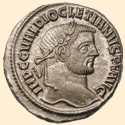
Lugdunum (Diœcesis Galliarvm, province of Lvgdvnensis I)Coins from Lugdunum are divided intwo two pages. Page covers coins from the first Tetrarchy, until the abdication of Diocletian and Maximianus. Page 2 continues with the second Tetrarchy until the closing of the mint under Constantine. A separate page includes coins struck by Constantius at the Bononia mint in preparation for his invasion of Britain, that are catalogued by RIC with the Lugdunum coinage.
104-971
Diocletian augustus
—struck by Constantius I
Lugdunum, 295
obv.- IMP C DIOCLETIANVS AVG; laur bust right
rev.- GENIO POPVLI ROMANI; Genius stg left holding cornucopia and patera; LA in ex
RIC VI Lug 2a
28mm; 9.9g; nummus
first issue from Lugdunum mint. Rated S in RIC
104-739
Maximianus augustus
—struck by Constantius I
Lugdunum, 295
obv.- IMP C MAXIMIANVS PF AVG; laur bust right
rev.- GENIO POPVLI ROMANI; Genius standing left, holding patera in left hand, cornucopiae in right; LA in ex
RIC VI Lug 2b; Fail 006
28mm; 12.6g; nummus
First issue from Lugdunum; rated S in RIC
104-940
Constantius I caesar
—struck by Constantius I
Lugdunum, 295
obv.- FL VAL CONSTANTIVS NOB C; laur bust right
rev.- GENIO POPVLI ROMANI; Genius standing left holding patera and cornucopia; LA in ex
RIC VI Lug 4a
28mm; 9.0g; nummus
First issue from Lugdunum mint
104-897
Galerius caesar
—struck by Maximianus
Lugdunum, 298
obv.- MAXIMIANVS NOB CAES; laur bust right
rev.- GENIO POPVLI ROMANI; Genius standing left holding a patera and cornucopiae. A in left field, PL in ex
RIC VI Lug 53b
28mm; 7.2g; nummus
204-125
Maximianus augustus
—struck by Constantius I
Lugdunum, 301-303
obv.- IMP MAXIMIANVS AVG; Laur. bust left; lion's skin on left shoulder, club over right shoulder
rev.- GENIO POPVLI ROMANI; Genius stg. left, modius on head, naked but for chlamys over l. shoulder, r. hldg. patera, l. cornucopia; altar in left field, A in right; PLC in ex
RIC VI Lug 85
27mm; 9.4g; nummus
Rated S in RIC, but probably much more rare than that. Great Hercules detail with great style.
104-903
Diocletian augustus
—struck by Constantius I
Lugdunum, 301-303
obv.- IMP DIOCLETIANVS P AVG; Laureate and cuirassed bust
rev.- GENIO POPVLI ROMANI; Genius standing left, holding patera and cornucopia, altar before; A in field; PLC in ex
RIC VI Lug 98a
29mm; 9.7g; nummus
listed as S in RIC
204-009
Maximianus augustus
—struck by Constantius I
Lugdunum, 301-303
obv.- IMP MAXIMIANVS P AVG; laur bust right
rev.- GENIO POPVLI ROMANI; Genius, towered, loins draped, stg left holding cornucopia and patera over alter; B in field; PLC in ex
RIC VI Lug 108b
27mm; 11.1g; nummus
104-916
Constantius I caesar
—struck by Constantius I
Lugdunum, 301-303
obv.- CONSTANTIVS NOB CAES;
rev.- GENIO POPVLI ROMANI; Genius standing left, holding patera and cornucopiae; B in field, PLC in ex
RIC VI Lug 129a
28mm; 7.82g; nummus
104-850
Constantius I caesar
—struck by Constantius I
Lugdunum, 301-303
obv.- CONSTANTIVS NOB CAES; helmeted and cuirassed bust left, holding sceptre over shoulder
rev.- GENIO POP-VLI ROMANI; Genius standing left, holding patera and cornucopiae; (altar)-B/PLC
RIC VI Lug 153
27mm; 9.6g; nummus
Ex Stephen M. Huston 107 (24 May 1991), 58. Rated S in RIC
104-521
Constantius I caesar
—struck by Constantius I
Lugdunum, 301-303
obv.- CONSTANTIVS NOB C; laureate cuir bust left
rev.- GENIO POPVLI ROMANI; Genius holding cornucopia and patera over alter, PLG in ex, A in field
RIC VI Lug 166a; Fail 25c
28mm; 8.7g; nummus
204-164
Galerius caesar
—struck by Constantius I
Lugdunum, 302-303
obv.- MAXIMANIVS NOB CAES; laureate, cuirassed bust left, holding sceptre over right shoulder
rev.- GENIO POPVLI ROMANI; Genius standing left, modius on head, holding patera over altar to left, cornucopia in right, B to right, PLC in ex
RIC VI Lug 167b
28mm; 10g; nummus
104-827
Galerius caesar
—struck by Constantius I
Lugdunum, 301-303
obv.- MAXIMIANVS NOB C; Laureate bust left, wearing imperial cloak, holding in his r. hand eagle-tipped sceptre
rev.- GENIO POPVLI ROMANI; Genius, nude but for chlamys over l. shoulder, standing facing, head with modius turned l., holding cornucopiae in his l. hand, sacrificing over lite altar out of patera in his r. hand; A in field, PLC in ex
RIC VI Lug 169b; Fail 025c
30mm; 10.2g; nummus
Bastien, Lyon 283c (this specimen, illustrated on pl. 26).
104-641
Galerius caesar
—struck by Constantius I
Lugdunum, 303-305
obv.- MAXIMIANVS NOB C; laureate cuirassed bust right
rev.- GENIO POPVLI ROMANI; Genius holding cornucopiae and patera over alter; star in field; PLC• in ex
RIC VI Lug 178b; Fail 025c
28mm; 9.4g; nummus
From the Father Wilbur B. Dexter Collection.
104-974
Constantius I augustus
—struck by Constantius I
Lugdunum, 305-306
obv.- IMP CONSTANTIVS AVG; laureate, cuirassed bust left
rev.- GENIO POPVLI ROMANI; Genius standing left, modius on head, holding patera over altar to left, cornucopia in right, * to right, PLC in exergue
RIC VI Lug 187a
29mm; 10.6g; nummus
104-767
Severus II caesar
—struck by Constantius I
Lugdunum, 305-306
obv.- FL VAL SEVERVS NOB C; laureate, draped and cuirassed bust right
rev.- GENIO POPVLI ROMANI; Genius standing left, modius on head, naked but for chlamys over left shoulder, right holding patera (from which liquor flows) above altar, left cornucopiae. * in field, PLC in ex
RIC VI Lug 193; Fail 046a
28mm; 12.75g; nummus
Rated S in RIC
204-008
Maximinus II caesar
—struck by Constantine I
Lugdunum, 305-307
obv.- GAL VAL MAXIMINVS NOB C; laureate, draped, cuirassed bust of Maximinus right
rev.- GENIO POPVLI ROMANI; Genius, towered, loins draped, stg left holding cornucopia and patera over alter; * in field; PLC in ex
RIC VI Lug 194a
29mm; 11.9g; nummus
rated S in RIC
204-010
Maximianus sr aug
—struck by Constantius I
Lugdunum, 305-306
obv.- D N MAXIMIANO FELICISSIMO SEN AVG; laureate bust right in imperial mantle & holding branch & mappa
rev.- PROVIDENTIA DEORVM QVIES AVGG; Providence standing right, extending hand to Quies, standing left, holding branch; T F in field; PLC in ex
RIC VI Lug 201
28mm; 10.8g; nummus
Rated S in RIC
204-070
Constantius I commem
—struck by Constantine I
Lugdunum, 306
obv.- DIVO CONSTANTIO AVG; laureate head right
rev.- CONSECRATIO; eagle standing right, head left; PLC in ex
RIC VI Lug 202
28mm; 11.6g; nummus
104-934
Maximianus sr aug
—struck by Constantine I
Lugdunum, 307
obv.- D N MAXIMIANO P F S AVG; laureate, cuirassed bust right
rev.- GENIO POP ROM; Genius standing left, wearing turreted crown, left shoulder and loins draped, holding patera and cornucopia, S—C in fields, PLC in exergue
RIC VI Lug 224 [var]
25mm; 6.9g; nummus
RIC records version with Genius wearing modius; this is quite clearly a turret. No turreted Genius types are officially recorded in the vicinity of this one, but one is described in a footnote of the previous issue, struck for Constantine. Listed as R for the normal 224. This is part of an interesting issue struck at Lugdunum when Maximianus was left in control of the city by Constantine after emerging from retirement. In place of the typical "abdication" follii struck for both augusti, with two figures of Providentia and Quiess on the reverse and the former emperor in consular robes—emphasizing civilian, not military authority—on the obverse, Maximianus struck a retirement nummus in Diocletian's name only, with only a single figure on the reverse. For himself, he struck coins in the style of the other active emperors: "Genio Populi Romani" on the reverse, and the armored bust of an active military leader on the obverse. To reinforce the claim to legitimacy, he added the classic S-C ("Senatus Consultus") on the reverse to give the impression of Senatorial sanction and echoing the motto typically found on Roman coins from the great days of the empire. 204-021
Constantine I caesar
—struck by Constantine I
Lugdunum, 307
obv.- FL VAL CONSTANTINVS NC; laureate, cuirassed bust right
rev.- GENIO POP ROM; Genius stg left, modius on head, holding patera and cornucopia; N in field, PLC in ex
RIC VI Lug 235
25mm; 5.5g; nummus
listed as R in RIC
104-765
Maximianus sr aug
—struck by Constantine I
Lugdunum, 307-308
obv.- IMP C VAL MAXIMIANVS P F AVG; laureate and cuirassed bust right
rev.- MARTI PATRI PROPVGNATORI; Mars, naked, advancing right, holding spear in right hand, shield in left, cloak flying behind, PLC in ex
RIC VI Lug 260 [var]; Fail 083; Bastien XI 480
28mm; 6.5g; nummus
This reverse type is simply unknown for Maximianus in RIC — it is only used by Constantine himself, except for a single rare issue for Maximinus II. That said, the existence of the Maximinus issue would imply a corresponding issue for Maximianus in the same series, which would be this coin.
104-591
Constantine I caesar
—struck by Constantine I
Lugdunum, 307
obv.- FL VAL CONSTANTINUS N C; laureate / draped bust right
rev.- GENIO POPULI ROMANI; Genius holding patera over alter, loins draped; N in field; PLC in ex
RIC VI Lug 214b; Fail 72
27mm; 6.9g; nummus
struck in spring 307. Rated S in RIC
104-782
Diocletian sr aug
—struck by Constantine I
Lugdunum, 307
obv.- D N DIOCLETIANO P F S AVG; Consular bust right
rev.- QVIES - AVGG; Quies draped stg left, holding a branch in right hand and sceptre in the left hand; S|C in fields, PLG in ex
RIC VI Lug 225; Fail 097; Bastien 444
25mm; 6.4g; nummus
From Daniel Compas collection. Prov. MONNAIES XVI, 31 décembre 2002, n 676. Same dies as the specimen of the Cabinet of the medals of the Museum of History and Art of Lausanne, Bastien n 444a, pl. XLIX. It is the fourth listed specimen. Will take the number 444c in Supplement III of Bastien.
This issue (emission 17), dated by Bastien to November-December 307, includes only small diameter and/or light weight nummi which are not otherwise attached to a normal issue. For this issue as a whole, we have 95 nummi in the corpus of Dr. Bastien in 1980, including only three nummi for Dioclétien with consular bust.
204-162
Constantine I augustus
—struck by Constantine I
Lugdunum, 307-308
obv.- IMP C CONSTANTINVS P F AVG; laureate draped bust right, seen from rear
rev.- CONSTANTINO P AVG B R P NAT; Constantine stg facing, head l., in military dress, r. holding globe, l. leaning on sceptre; PLC in ex
RIC VI Lug 252
28mm; 5.9g; nummus
Rated R in RIC. The reverse legend CONSTANTINO P AVG B(ono) R(ei) P(ublicae) NAT(o), means "To Constantine, prince, Emperor, born for the welfare of the state." This likely commemorates Constantine's birthday on 27 February 308. Constantine would have 27 or 28 for this birthday.
204-205
Constantius I commem
—struck by Constantine I
Lugdunum, 307-308
obv.- DIVO CONSTANTIO PIO; Laureate, veiled, cuirassed bust right
rev.- MEMORIA FELIX; Altar of cippus form, lighted and garlanded; eagle standing to either side; PLC in ex
RIC VI Lug 268
26mm; 7.1g; nummus
204-161
Constantine I augustus
—struck by Constantine I
Lugdunum, 307-308
obv.- IMP C CONSTANTINVS P F AVG; laureate draped bust right, seen from rear
rev.- SECVRIT PERPET DD NN; Securitas stg. l., leaning l., with transverse sceptre on column, r. raised to head; PLC in ex
RIC VI Lug 278
27mm; 6.3g; nummus
Rated S in RIC, but I suspect it's a bit rarer than that…
104-761
Constantine I augustus
—struck by Constantine I
Lugdunum, 308
obv.- IMP C CONSTANTINVS PF AVG; laureate draped bust right
rev.- GENIO POP ROM; Genius holding patera over altar; CI - HS in fields, PLC in ex
RIC VI Lug 287; Fail 073
27mm; 6.2g; 308-309
A historical bronze dating to marraige of Constantine to Fausta. The CI in the left field stands for Constantine Imperator and declares his new title along with his new father in law. The horizontal HS stands for Heraclius Senior giving honor to his new father in law. The coin is a clear commemoration of Constantines new position in the tetrarchy and his new wife and her family. Rated S in RIC
104-970
Maximianus sr aug
—struck by Constantine I
Lugdunum, 308-309
obv.- IMP C VAL MAXIMIANVS P F AVG; Laureate, cuirassed bust right, parallel laurel ties
rev.- GENIO POP ROM; Genius standing facing, head left, modius on head, loins draped, patera in right hand over lighted altar, cornucopiae in left ; C-I | H / S across fields ; PLC in exergue
RIC VI Lug 288
26mm; 6.3g; nummus
204-120
Constantine I augustus
—struck by Constantine I
Lugdunum, 309-310
obv.- IMP CONSTANTINVS P F AVG; Laureate bust right, cuirassed, draped, seen from rear
rev.- SOLI INVIC-TO COMITI; Sol radiate, stg. l., chlamys draped over l. shoulder, r. raised, l. holding up globe. F-T in fields, PLC in ex
RIC VI Lug 310
24mm; 4.2g; nummus
I love the figure of Sol on the reverse; click here for extra close-up view.
104-816
Constantine I augustus
—struck by Constantine I
Lugdunum, 314-315
obv.- IMP CONSTANTINVS PF AVG;
rev.- MARTI CONSERVATORI; T|F in field; PLG in ex
RIC VII Lug 12; Fail 204
20mm; 3.9g; nummus
The coins ascribed to Lugdunum traditionally include a number of coins with no mintmark on the reverse, that stylistically are separate from the London mint coins that do not have a mintmark. These coins are thought to have been struck in preparation for Constantius' invasion of Britain in 296, and thus predate the unmarked coins known to have been struck in London. Recent scholarship assigns these coins to a mint in northern Gaul that was set up expressly to strike coins before the invasion, perhaps staffed by workers transferred from the Lugdunum mint (on account of the stylistic similarity). It is thought that this mint was located in Bononia (modern Boulougne), the important port conquered by COnstantius and likely used as the staging area for the invasion. 204-028
Maximianus augustus
—struck by Constantius I
Lugdunum, 295-296
obv.- IMP C MAXIMIANVS PF AVG; laureate bust right
rev.- GENIO POPVLI ROMANI; Genius, stg.l., holding patera in r.hand, cornucopiae in l.
RIC VI Lug 14b
29mm; 10.3g; nummus
204-084
Constantius I caesar
—struck by Constantius I
Lugdunum, 295-296
obv.- FL VAL CONSTANTIVS NOB C; laureate bust right
rev.- GENIO POPVLI ROMANI; Genius standing with patera and cornucopiae, modius on head; no mint marks
RIC VI Lug 17a
26mm; 13.2g; nummus
During much of the first and second centuries, Lugdunum was one of the most important cities in the empire. The mint at Lugdunum dates from 19 BC and for much of this time was the most important imperial mint besodes Rome itself. By the time of Diocletian, the city's importance had declined, eclipsed in military significance by other cities more directly located on the German frontier such as Treveri, but was still an important enough administrative center to justify an imperial mint in Diocletian's decentralized administration. Under Constantius, workers from the mint issued the coinage preparatory to his invasion of Britain, perhaps striking the coins at Bononia (see neighboring tab). Under Constantius' control, the mint struck the same standard Genio Populi Romani coins as the other mints, but quickly developed its own distinctive style; after about 301 or so, the portraits have a much more angular, geometric style than the other western mints, resembling more the eastern style. Interestingly, this stylistic transition happened at the same time as the neighboring mints in Treveri and Ticinum transitioned to the Moneta reverse, which was never adapted at Lugdunum. Lugdunum coins were also distinctive for the altar on the reverse, and, like the Treveri mint, used an unusually diverse set of bust types. The Lugdunum mint was fully part of Constantine's sphere of control as he began his rise to power, although clearly subordinate to Treveri. Portraits of Constantine are stylistically similar to those from his other main mints in London and Treveri. During the politically tumultuous years of 308–310 the mint struck a large number of distinctive reverse types commemorating various aspects of Constantine and his rule. The mint operated somewhat sporadically during the latter part of Constantine's reign, as the empire's center of gravity continued to shift eastward; it was closed from 316–319 or 320, and again from 325–330.
|
Timeline43 BC — City is founded by Lucius Munatius Plancus, once of Caesar's chief officers during his conquest of Gaul, as a colony for displaced Roman refugees. Original name was Colonia Copia Felix Munatia. City gradually becomes known as Lugdunum following local usage. 15 BC — Augustus establishes imperial mint in Lugdunum. 10 BC — Future emperor Claudius is born in Lugdunum. 19 AD — First amphitheatre in Gaul is built here. 69 — Vitellius proclaimed emperor in Lugdunum. 177 — First Christian persecutions in Gaul lead to martyrdom of Lugdunum's first bishop plus 40 others. St. Irenaeus succeeds as Bishop of Lugdunum and becomes important theologian.180 — Irenaeus writes Adversus Haereses ("Against Heresies"). 197 — On Feb 19, Battle of Lugdunum between forces of Septimius Severus and Clodius Albinus. 310 — The supposedly retired Maximianus attempts to seize mint in bid to reclaim power; quickly put down and executed. |
|
| ||